This blog is entitled "Save the planet movement" because it is - as it says. All the contents of this blogsite is intended to serve the needed knowledge required by anyone concerned in doing his part in saving the planet.

Monday, October 5, 2009

Wind Power Could Supply Global Electricity Needs 40 Times Over


ISIS Report 05/10/09
Dr. Mae-Wan Ho

Wind power could electrify the world or provide its energy needs many times over, not necessarily with big turbines and wind farms

The enormous potential of wind power

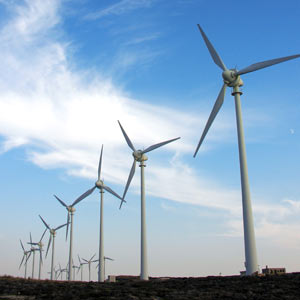
Wind turbines on land could provide more than 40 times the world’s current electricity consumption or over five times its total energy needs. That’s the latest assessment using wind data from meteorological sources [1]. A network of 2.5-megawatt (MW) turbines on land restricted to non-forested, ice-free, nonurban areas operating at as little as 20 percent of their rated capacity would do the trick; allowing for the fact that the wind does not blow constantly. To put this into perspective, wind turbines installed in the US in 2004 and 2005 operate on average 36 percent of rated capacity.

For the United States, the central plain states could accommodate enough wind turbines to provide as much as16 times its total current demand for electricity.

Wind power is on a steep ascent. It accounted for 42 percent of all new electrical capacity added to the US in 2008; but it is still only a tiny fraction of the total capacity, 25.4 GW out of 1 075GW. The Global Wind Energy Council projected a 17-fold increase in wind-powered generation of electricity globally by 2030.

Simulating global wind fields based on state-of-the-art data Xi Lu and Michael McElroy at Harvard University, Cambridge Massachusetts in the United States and Juha Kiviluoma at the Technical Research Centre of Finland based their study on a simulation of global wind fields from version 5 of the Goddard Earth Observing System Data Assimilation System (GEOS-5 DAS) that includes global meteorological data from a wide variety of sources including surface and sounding measurements, measurements and observations from aircraft, balloons, ships, buoys, dropsondes (radio probe dropped by parachute) and satellites; the gamut of data that can provide the world with the best possible meteorological forecasts enhanced by application of these data in a retrospective analysis.

The land-based turbines are assumed to have a rated capacity of 2.5 MW with somewhat larger turbines, 3.6 MW, deployed offshore, to take account of the greater cost of
construction and the economic incentive to build larger turbines to capture the higher wind speeds available there.

In siting turbines on land, the study excluded densely populated regions and areas occupied by forests and environments distinguished by permanent snow and ice cover
(notably Greenland and Antarctica). Turbines located offshore were restricted to water depths less than 200 m and to distances within 92.6 km off shore.

Optimal spacing of the turbines in an individual wind farm involves a trade off between various costs: turbines, site development, laying power cables, routine operations and maintenance. Turbines must be spaced to minimize interference in airflow and requires a compromise between maximizing power generation per turbine and maximizing the number of turbines sited per unit area. For example, restricting overall power loss to < 20 percent requires a downstream spacing >7 rotor diameters, and a cross-wind spacing of > 4 diameters.


The power yield is assumed to be only a fraction (20 percent) of the maximum potential to account for the variability of the wind over the course of a year.


In this way, a world map of the annual wind power potential (W/m2) is obtained; and the country by country potential for both on land and off shore wind power also represented.

You may read the rest of this document here
http://www.i-sis.org.uk/windPowerElectricity.php

Saturday, October 3, 2009

The Illussion of Overpopulation


Overpopulation panic's eternal return

Ronald Bailey | July 28, 2004


The world has never been overpopulated with humans in any meaningful sense. It seems, though, that it is overpopulated with theoretical fears of overpopulation.

The appeal of the overpopulation myth is obvious-who doesn't love a simple, easily graspable idea that seems to explain a great deal? One such idea is the central biological insight that all animals aim to turn food into offspring. When a species' food increases, then its population grows as well; and when the food supply declines, so too do its numbers. This applies to everything from paramecia to parakeets.

Since humans are also animals that reproduce, biologists have extended that insight to us as well. This is the source of the overpopulation fears that have haunted learned experts from Thomas Robert Malthus 200 years ago to Paul Ehrlich today.

An extensive literature critiques the concept of human overpopulation. But it's apparently an idea whose time comes again, and again, and again, in all sorts of strange places. For instance, the 1990s saw a bad novelization of the concept in Ishmael, in which a telepathic gorilla recycles Malthusianism.

The latest iteration of this two-century-old idea comes from Duke University consultant Russell Hopfenberg, in an article called "Human Carrying Capacity Is Determined by Food Availability", in the November 2003 issue of the journal Population and Environment. Hopfenberg writes, "[T]he problem of human population growth can be feasibly addressed only if it is recognized that increases in the population of the human species, like increases in the population of all other species, is a function of increases in food availability."

Hopfenberg backs his argument by showing that global food supplies and human numbers both rise from 1960 to 2000. In 2001, Hopfenberg, writing with Cornell University ecologist David Pimentel in Environment, Development and Sustainability, further asserts that "if food production continues to increase, the world population is projected to increase to 12 billion in the next 50 years (based on current growth rates)." Hopfenberg's solution to skyrocketing human numbers is simple: "Cap the increases in food production and thereby halt the increases in population by means of a reduced birth rate."

So has the Malthusian case finally been proven? No. Hopfenberg's analysis makes the mistake of considering only global numbers. This hides a great deal of information. If we look on the regional level we see a very different picture than one of a relentlessly rising tide of human babies. Fertility does not correlate with food availability.

The countries with greatest access to food are, in fact, the countries with the lowest fertility rates. As the United Nations reports, 14 developed countries have fertility rates lower than 1.3 children per woman. (Replacement fertility is 2.1 children per woman.) The fertility rates in practically all developed countries are below the replacement rate. Clearly, food availability does not mean more children. More generally, as food security has increased around the world, instead of increasing as Hopfenberg's theory would suggest, global average fertility rates have dropped from 6 children per woman in 1960 to 2.6 today. And the rates continue to plummet. Sadly, in Africa, which has the highest current fertility rates, food production per capita has been declining for nearly 30 years.

If food availability really determined human reproductive capacity, Illinois farmers should have the highest fertility rate in the world. Instead, they have one of the lowest. Hopfenberg would reply that excess food produced in North America and Europe fuels population growth in the rest of the world. In some sense that is trivially true, but the strictly biological model that he says applies to people does not account for such phenomena. For example, deer in Virginia don't sacrifice their chances to produce fawns and ship their food to deer in Arkansas, nor do sparrows in New York forego nesting in order to supply food to Floridian sparrows. Individuals, not populations, reproduce.

The notion that capping food supplies will halt population growth is also trivially true, but not by the gentle means which Hopfenberg and Pimentel suggest, e.g., reducing human birth rates. Food shortages no doubt reduce fertility, but they also shrink population much more quickly by simple starvation.

Finally, Hopfenberg and Pimentel's projection that world population will reach 12 billion by 2050 is off. They simply extrapolate current levels of fertility, yet as we've seen, fertility rates are rapidly declining. The 2002 revision of the United Nations' World Population Prospects' median variant trend projects a world population of 8.9 billion by 2050. Given the rapidly falling global fertility rates, the low variant trend is more likely-and that projects a world population topping out at 7.5 billion by 2040, then beginning to decline. Perhaps Malthusianism will finally decline along with fertility rates.

------------------------------------------------------------------------------------

My Take on this:
by: ehnriko

In my Honest Observations...

Overpopulation can be concluded as merely a myopic perception of a broader problem caused by Inefficient human density distribution.

If you will notice how many people overcrowding an urban location in contrast with how much less people are staying in rural locations... the difference is too obvious.

If we follow the blaming arrow where it ends... we will only find the usual suspects behind them.

It is the same all over the world. People tend to go where the crowd leads. This is a sort of herd or flock instinct - driven by the fact that Man is a social being.

Modern Technology offers an alternative social venue for people to crowd... the internet. Making this technology wireless and less dependent on power from the grid will allow a more less dense physical demographic landscape for the urban and suburban spots.

However, poverty needs to be addressed first using a dynamic approach driven with enthusiasm from the leaders. Nothings ever gets done without enthusiasm... The enthusiasm needs to be genuine... and not the normally mistaken enthusiasm; i.e., The greed driven passion for more money, power and control.

More to come.

The world can be 100 percent renewable by 2050

“A must-read for saving the climate”

ISIS Report 30/09/09

Announcing ISIS/TWN Special Report
Green Energies 100% Renewables by 2050
#################################

By Mae-Wan Ho, Brett Cherry, Sam Burcher & Peter Saunders

What Green Energies says; The world can be 100 percent renewable by 2050

• A variety of truly green and affordable options alreadyexist, and more innovations are on the way

• Policies that promote innovations and stimulate internal market for decentralized distributed generation are key

In 2008, for the first time, more renewable energies capacity was added globally than conventional energies, and the trend continues

Wind energy alone can supply 40 times the world’s electricity or 5 times its total energy consumption. PV technologies are improving by leaps and bounds, and electricity from solar panels is already as cheap as electricity from the grid. Biogas from wastes has transformed rural China, and waste-incinerating community cookers poised to do the same in Africa. Air condition and energy from deep water, saline agriculture for food and
fuel, and estuarine reef for tapping tidal energy are further options in addition to well established micro-hydroelectric and geothermal energies.

Promising developments on the horizon include thermoelectrics for recycling waste heat into electricity, artificial photosynthesis for harvesting and storing solar energy, and the potential for solving our nuclear waste problem by low temperature transmutation.

These are exciting times. All we need to save the planet is for our leaders to follow the way of nature and the will and wisdom of the people.

PREFACE

350 PPM THE NEW TARGET

Global warming is happening much faster than the IPPC (Intergovernment Panel on Climate Change) predicted in its latest 2007 report. For one thing, its climate models failed to account for the rapid summer melting of the polar ice caps that’s been making headlines several years in a row.

The IPCC helped set the target of 450 ppm maximum of atmospheric CO2, which they thought would limit the global temperature rise to below 2 °C, and prevent “dangerous
anthropogenic interference with the climate system.”

But top climate scientists Jim Hansen and colleagues, using more realistic climate models and key data from the remote history of the earth, showed that 450 ppm is well beyond the danger zone, and we must even reduce the current 385 ppm atmospheric CO2 down to 350 ppm, or else face “irreversible catastrophic effects”. And the head of IPCC Rajendra Pachauri now agrees.

The good news is that we can still do it. It is not too late. All it takes is to stop burning fossil fuels in order to bring 385 ppm back down to 350 ppm within the next decades. But we must act now, because 385 ppm is already within the danger zone, and we cannot afford to let it remain there for too long, or we push the planet past the point of no return.

That is why we need to commit ourselves to truly green energies as a matter of urgency

Read the rest of this announcement for the full executive summary and contents
http://www.i-sis.org.uk/GreenEnergies.php

Thursday, October 1, 2009

Weather Forecast Update on "SUPER" Typhoon "PARMA". Thursday CNN

Weather Forecast Update on "SUPER" Typhoon "PARMA". Thursday CNN

SUper Typhoon Pepeng... much worse than Ondoy...


Signal No. 1 hoisted over 6 provinces

Latest DOST-PAGASA MTSAT-EIR Satellite Image (timestamp on image is UTC; add 8 hours to convert to Philippine Standard Time)

MANILA - Weather bureau PAGASA on Thursday said typhoon Pepeng (international codename Parma) is forecast to bring more rains and very strong winds in Northern Luzon including Metro Manila once it makes landfall Saturday afternoon.

In a press conference Thursday afternoon, PAGASA said Pepeng has intensified further, now packing winds of 195 kilometers per hour near the center, and gusts of up to 230 kph.

As of 5 p.m., PAGASA weather branch chief Nathaniel Cruz said the typhoon was sighted 440 km east of Catarman, Northern Samar and is moving 24 kilometers per hour in the general direction of Northern Luzon and the Taiwan area.

Typhoon Pepeng (Parma): Forecasts

Philippine Atmospheric, Geophysical and Astronomical Services (PAGASA): Tropical Cyclone Update

Manila Observatory

Japan Meteorological Agency

Taiwan Central Weather Bureau

Hong Kong Observatory

World Meteorolgical Organization (WMO) Severe Weather information Centre

US Navy: Joint Typhoon Warning Center

The typhoon is expected to be 100 km northeast of Virac, Catanduanes or 300 km southeast of Baler, Aurora by Friday afternoon.

Cruz said the typhoon is forecast to make landfall over Aurora-Isabela by Saturday morning or afternoon. He said the typhoon will bring occasional rains over the eastern section of Luzon and Visayas and more frequent rains in Samar and Bicol Thursday afternoon.

Gale-force winds are also forecast over Visayas and Mindanao.

Storm Signal no.1 has been hoisted in Camarines Norte, Camarines Sur, Catanduanes, Albay, Quezon (including the Polilio Islands), and Aurora.

"Residents in low-lying areas and near mountain slopes under signal #1 are advised to take all the necessary precautionary measures against possible flashfloods and landslides," the PAGASA weather bulletin stated.

"The public and the disaster coordinating councils concerned are advised to take appropriate actions and watch for the next bulletin to be issued at 11 P.M. today (Thursday)," it added.

Stronger than Ondoy, similar to Reming

Cruz, in an earlier press conference, said Pepeng is much stronger than last Saturday's tropical storm Ondoy (international codename Ketsana), which brought record amounts of rainfall and triggered the worst flooding in Metro Manila in 40 years.

"In terms of wind intensity, Ondoy was only half of the strength of Pepeng. When it made landfall, Ondoy only had winds of 85 kph while Pepeng is 175 kph. However, we cannot really compare the two because it was the rain that was really destructive about Ondoy," he said.

He added: "Our major concern with Pepeng is the disastrous winds - 175 kph to 210 kph. We expect typhoon Pepeng to intensify further as it moves towards northern Luzon."

He said the weather bureau will give a forecast on the typhoon's estimated rainfall intensity before it makes landfall.

Cruz also likened typhoon Pepeng to super-typhoon Reming (international codename Durian), which killed at least 734 people in the country in 2006.

"This could be like Reming. We are not just talking here about Metro Manila. We are talking of the entire Luzon area where there is probability of devastation in terms of flooding...and wind," he said.

Dams to release water

Dr. Susan Espinueva, assistant weather services chief of the Hydro Metrological Division of PAGASA, said major dams in Northern Luzon have been releasing water before Pepeng hits.

"All major dams in Northen Luzon wll be releasing water to lower the water level so that when the storm hits, there will be a buffer of storage capacity in our dams and the spillover will not be as severe,' she said.

Among the dams that have released water are the Angat Dam in Norzagaray, Bulacan; Binga Dam in Itogon, Benguet Province; Ambuklao Dam in Bokod, Benguet; Magat Dam in Ramon, Isabela province; and Pantabangan Dam in Nueva Ecija.

Espinueva said Angat Dam started releasing water since 10 a.m. Tuesday to lower the water level from 214 to 212 meters. She said maximum outflow of 500 cubic meters per second was released from the dam.

She said that as of 3 p.m. Friday, the Caliraya Dam in Lumban, Laguna also started releasing water. "Water coming from the dam will affect the towns of Lumban and Pagsanjan," she said.

The government has started preparing more evacuation centers as it anticipates more people to be displaced by the new storm.

Disaster officials fear more rains spawned by the typhoon could trigger another massive flood as streets and drainage systems remain clogged from the tons of debris left by the previous deluge caused by tropical storm Ondoy (international codename Ketsana).

As of 6 a.m., the National Disaster Coordinating Council said more than half a million families of 2.50 million individuals have been affected by Ondoy in 11 regions, including Metro Manila and the Calabarzon area in southern Luzon.

It said that a total of 686,699 people are now staying in 726 evacuation centers. It said Ondoy’s death toll has reached 277 and 42 were still missing.

The storm, which also devastated Vietnam and Cambodia, damaged crops and infrastructure worth at least P4.80 billion.

Coast Guard limits sea travel

Coast Guard commandant Vice-Adm. Wilfredo Tamayo said he has placed all Coast Guard units in affected areas of the new storm on heightened alert.

He said all sea vessels below 1,000 gross tonnage have been barred from sailing in Catanduanes, Camarines Sur and Camarines Norte as of Thursday morning.

"If Storm Signal no. 2 is hoisted, no vessel will be permitted to sail. We are warning fishing bats and smaller vessels not to venture out to sea. Maritime travelers going to the affected areas are advised to delay their trips," he said. . With a report from the Agence France-Presse

Wednesday, September 30, 2009

Ketsana Hits Cambodia September 29, 2009


The powerful typhoon that has hit the Philippines and Vietnam with deadly force is now battering Cambodia.

At least nine people have died in Kampong Thom province in central Cambodia.
When Typhoon Ketsana hit Vietnam, more than 30 people were killed and almost 200,000 people fled their homes; severe flooding remains in central provinces.
In the Philippines, where the typhoon hit over the weekend, at least 246 people are known to have died.
Relief officials in the Philippines, struggling to feed and shelter hundreds of thousands of displaced people, admit they have been overwhelmed by the disaster.
They warn that new storms are heading towards the country.
Cambodia caught
In Vietnam, Ketsana hit with torrential rains and winds of more than 150km/h before it headed inland towards northern Cambodia and southern Laos.
Typhoons usually weaken on reaching land, but Ketsana is still dangerous, officials said.
"At least nine people were crushed last night when their house fell down," said Chea Cheat, chief of the Red Cross office in Kampong Thom province, about 130 km (80 miles) north of the Cambodian capital Phnom Penh.
He added that at least 78 houses in his province were destroyed and that heavy rain and rising floods were continuing.
International organisations and government officials in Cambodia said they were distributing tents and food to affected people while assessing damage across at least five of the country's provinces.
Vietnam floods
The BBC's Guy De Launey in Phnom Penh said that Ketsana had been devastating when it headed toward the city of Danang, on central Vietnam's coast.
The airport and schools were closed. Railways and roads linking north and south Vietnam were cut off. Danang airport has since reopened.
The biggest floods in decades now threaten Vietnam's central provinces, correspondents said, with thousands of homes inundated with water.
Vietnamese state media reported that at least 33 people had died from floods and landslides in seven coastal and central highland provinces, and river waters in Quang Nam provinces could reach a level last seen in 1964.
Around 170,000 people were evacuated before the typhoon made landfall.
Vietnam's Deputy Prime Minister Hoang Trung Hai said late on Tuesday that he hoped power supplies would be restored quickly, particularly to Quang Ngai province where Vietnam's first oil refinery, Dung Quat, was due to reopen after an outage shut the plant's test runs last month.
Overwhelmed

In the Philippines, the government said it now believed 246 people had died after the storm struck on Saturday, a figure that is expected to rise as mud is cleared from the worst affected areas.
Almost two million people were affected by the flooding in Manila, the worst to hit the city in 40 years. At one point, 80% of the city was submerged.
Ketsana, with winds of up to 100km/h (60mph), hit the Philippines early on Saturday, crossing the main northern Luzon island before heading out toward the South China Sea. Officials say more than 40cm (16in) of rain fell on Manila within 12 hours, exceeding the average for the whole month of September.
Meanwhile forecasters said a new storm forming in the Pacific Ocean was likely to enter Philippine waters on Thursday and make landfall later on the northern island of Luzon.

Ondoy - Ketsana Wrecks Havock in Vietnam - September 29, 2009


By TRAN VAN MINH, Associated Press Writer – Tue Sep 29, 10:14 am ET
HANOI, Vietnam – Typhoon Ketsana roared into central Vietnam on Tuesday, killing at least 23 people as it brought flooding and winds of up to 90 mph (144 kph), disaster officials said. Some 170,000 were evacuated from its path.
Ketsana left more than 200 dead across the northern Philippines as a weaker tropical storm.
After gathering strength over the South China Sea, the typhoon made landfall in midafternoon, about 37 miles (60 kilometers) south of Danang, according to the National Weather Center.
Two people in Quang Nam province were killed by falling trees, and another died when struck by a power line, said Nguyen Minh Tuan, a provincial disaster official.
"The rivers are rising and many homes are flooded, and several mountainous districts have been isolated by mudslides," Tuan said.
Another three died in Thua Thien Hue province, disaster official Le Minh said. A man was killed by a falling tree, a woman died in floodwaters and a 3-year-old drowned in a flooded home.
As the storm moved inland toward Laos, nine people died in Kon Tum province in the Central Highlands, including a family of five whose house was buried in a mudslide, disaster official Nguyen Van Vy said.
Deaths were also reported in Danang and the province of Binh Dinh and Quang Ngai.
Some flooding was reported in Hoi An, a UNESCO World Heritage site in Quang Nam province, but no serious damage was reported.
The storm weakened as it approached Laos, and by Tuesday evening, the rain had stopped along some parts of the coast.
River levels were still rising, however, and more rains are forecast for the region Wednesday.
Authorities evacuated 170,000 people from six central provinces as the typhoon approached and heavy winds began lashing Vietnam's central coast in the morning, officials said.
"There's a blackout across our entire province," said Truong Ngoc Nhi, vice governor of Quang Ngai province, south of Danang. "Streets are strewn with fallen trees and utility poles. It looks like a battlefield."
Vietnam Airlines canceled all flights to the tourist destinations of Danang and Hue and travelers were stranded along the central coast.
The typhoon ruined the wedding of Bui Thi Anh Nguyet, a 24-year-old-bride who consulted a fortune teller before setting the date for her nuptials.
According to Vietnamese tradition, the groom comes to the bride's hometown, picks her up and brings her to his hometown for the wedding. Nguyet had planned to marry in Danang, but the wedding party got stuck in Binh Dinh province, some 300 kilometers (180 miles) from Danang.
"We had been preparing for this wedding since January, and we chose today as our most auspicious and happiest day, but now we are stranded," Tuyet said telephone. "Parts of the highway are flooded. I don't know how long we'll be stuck here."

Compute your carbon footprint

Calculate your Car's Carbon Impact
Based on EPA and Intergovernmental Panel on Climate Change (IPCC) Values
Trip Carbon Footprint Calculator for Gasoline Engine
Miles Driven Trip MPG Average
Trip Carbon Impact
City:
lbs. of CO2
Highway:
lbs. of CO2
Total Trip Emission:
lbs. of CO2
How many times do you drive like this per month?
Estimated Annual Emission:
Tons of CO2

PANACEA-BOCAF

This idea describes two technologies that can help every person on the planet, save energy, stop pollution and help reduce global warming. We need your help to help you please vote for this idea.

URGENT MESSAGE #1

I personally do not agree with idolatry or cult personalities - I am merely posting these videos for the worthy educational contents - and I am not endorsing any of the perosnality intending to be idolised or praise or worshipped in these videos. Please stick with the contexts or contents only and discard the unimportant details like superlative titles to individuals.