This blog is entitled "Save the planet movement" because it is - as it says. All the contents of this blogsite is intended to serve the needed knowledge required by anyone concerned in doing his part in saving the planet.

Monday, December 28, 2009

Australia pledges to cut emissions by up to 15%


Here's an old news but worth taking into account with the present Copenhagen Climate Talks Hype. For everyones reference.


-ehnriko-.


Australia today pledged to cut its greenhouse gas emissions by 5%-15% by 2020 via the world's broadest cap and trade scheme.
Business analysts believed that industry overall would be relieved at the trimming of some of the costs to polluters but environmental campaigners condemned the deal.
The prime minister, Kevin Rudd, said the interim plan would not affect his commitment to slash the carbon emissions that are blamed for global warming by 60% from 2000 levels by 2050.
"Australia is today the biggest carbon polluter in the developed world on a per capita basis," Rudd said. "Yet we are the developed country with the most to lose from climate change."
He added: "Without action on climate change, Australia faces a future of parched farms, bleached reefs and empty reservoirs."
Australia's plan is only exceeded in scale by the European Union'semissions trading scheme. On Friday, European leaders committed the bloc to a 20% cut in greenhouse gases, relative to 1990 levels, by 2020. This would rise to 30% if the UN negotiations culminating in Copenhagen in December 2009 deliver a global emissions deal. The upper 15% cut in the Australian deal has the same trigger.
Both these targets fall short of the the cuts of 25%-40% by 2020 demanded by the scientists contributing to the UN's Intergovernmental Panel on Climate Change, in order to avoid a high risk of catastrophic climate change.
The Australian cut is relative to 2000 emissions levels, a tougher reference year than Europe's 1990. Rudd argued that his new plan exceeded the cuts in the EU plan in terms of the emissions reduced per capita.
The Australian government were caught in the same dilemma that faced Europe's leaders on Friday: the need to start cutting greenhouse gases very soon to prevent long term climate catastrophe versus the need to support industry and business in the short term during a deep and global economic downturn.
The government said the scheme would only trim about 0.1% off annual growth in gross national product from 2010 to 2050, with a one-off increase in inflation of around 1.1%.
"You could say that the decision came down to a choice between the environment and the economy and at this stage it looks like the economy has won," said Gary Cox, head of environmental derivatives at global brokers Newedge.
Green groups agreed. "The weak targets announced today will damage Australia's international reputation and hold back progress toward an effective international agreement [in Copenhagen]," Australian Conservation Foundation executive director Don Henry said.
Frank Jotzo, an Australian National University economist who specialises in climate change policy, concurred. "It's disappointing because it makes it very difficult, if not impossible, for Australia to come to the party of an ambitious international agreement," Jotzo said.
Australia's largest business group, the Australian Chamber of Commerce, said it remained apprehensive about being burdened with pollution reduction targets during the current economic slowdown.
But Rudd said the global economy could not excuse failing to act on global warming.


The details of the plan


• Permits to emit carbon dioxide will be auctioned by the government in the first half of 2010, raising an estimated A$11.5bn in 2010/11. This money will be used to compensate businesses and consumers for higher power and fuel costs. In future, the number of permits will be reduced, leading to reductions in emissions.
• Three-quarters of the nation's emissions will be regulated by the scheme. Billions of dollars are earmarked as compensation for the coal-fired power industry, which accounts for about 80% of Australia's electricity generation and about a third of national emissions. There are also major exemptions for companies that could lose business to overseas competitors which operate in nations that do not require them to buy carbon permits.
• Iron and aluminium producers, like BHP Billiton, Alcoa and Rio Tinto, will get up to 90% exemptions, while liquid natural gas producers, like Chevron and Woodside Petroleum, will get up to 60%.
• The price of the permits is set by the market. The government estimated an initial price of about A$25 (£11.10) a tonne, lower than the European emission allowances, which are trading around €15 (£13.50) a tonne. However, there will be a government-imposed cap of A$40 a tonne for four years, which puts a ceiling on the costs for industry but will undermine the use of carbon reduction technologies that cost more that $40.
• Transport and fuel are included in the scheme, but agriculture, responsible for 16% of the nations emissions, is exempt for at least five years. The government will introduce the carbon trading laws in 2009.

Sunday, December 27, 2009

The Truth is in the Floods!


by Fr. Shay Cullen
from PREDA Foundation

The truth about climate change is essential to the Copenhagen Conference and its aftermath. The nations of the world have not reached a comprehensive breakthrough agreement but the world desperately needs one to greatly reduce the outpouring of greenhouse gasses.

The people and especially the poor in developing countries who are being impacted daily and will be most affected by rising ocean levels, greater storms, floods and droughts in the future have little real say in the deliberations or the decisions. The rich and the powerful nations will be deciding the future of the planet as they have already done for centuries. Their economic wealth and military power has been built on the exploitation of the poorer nations, extracting their cheap low cost raw materials, processing them with fossil fuels and destroying the atmosphere as they grow rich. They grow richer by selling back to the poor nations high-priced manufactured goods as they have done for the past five hundred years.

The rich nations have made sinful alliances with the corrupt rulers of the poor nations to achieve this immoral and unjust exchange. However, wealthy nations like Australia foster coal-burning power plants on the poor nations like they have done and are doing in the Philippines and lock them into long term supply deals.

Coal is used to meet nearly 40% of the world’s current energy demand, creating over 40% of annual global carbon emissions. Global coal consumption is expected to rise by 1.9% to 4.2 billion tonnes by 2010. Australia is the worldís largest exporter of black coal, a position it has held since1984.

The Australian Senate has blocked a new law that would help reduce the carbon emissions. Australia is contributing to the global warming while talking hot air in Copenhagen. How much better to finance geothermal power generation that has zero CO2 emissions for local power generation so feasible in the volcanic Philippines? But no, they want to sell Australian coal and the ruling Philippine elite decide in cahoots with them against the national interest of Filipinos. The Filipinos are the ones that suffer most.

The Indigenous People of the Aeta communities of Botolan, Zambales, not far from where I live, have suffered a total wipe out of their community, houses, simple fans, a small TV for which they saved for months all gone. Some died, most mercifully escaped. But their small farms and a secure future are all gone. They are refugees on waste land. I go there every ten days with relief food to help keep them going while planning a small re-housing project with the help of the Irish Church relief agency Trocaire – a small help for a massive problem.


A coal stacker pours coal into piles ready for export in Newcastle, Australia. Photograph: Mick Tsikas/Reuters

Climate change damages and destroys thousands of lives. Antong is a tribal leader of the Aeta people here in Zambales province the Philippines. I sat with him in an impoverished makeshift refugee camp with tiny shelters made of grass hovels and plastic sheets. He told me the recent devastation that wiped out his village and all their lands.

He is knowledgeable about Global Warming and knows that the blocking of the atmosphere with gasses from factories and millions of vehicles heats the oceans and brings ten times the evaporation of the seas and ten times the amount of rain all in a few days. Nothing can stop the raging waters that cover the lands and washes away the soil and leaves behind sand and stones. If only the negotiators in Copenhagen could see and understand this, they might agree more readily to really curb emissions.

ìNow we are impoverished and 100 families are huddled here, the rest have scattered, I know not where they wentî, he lamented as the relief workers handed out plastic bags of rice and canned goods.

A once proud people and a simple sustainable village life swept away in the deluge. They are the human face of global warming. They suffer the consequences of the high living of the rich and empty promises, this will not change unless all of us common people get out and rally and campaign for true global cuts in emissions and demand justice for the victims of global warming and climate change. END

^~^~^~^~~^~^~^~^~^~^~^~^~^~^~^~~^~^~^~^~^~^~^~^~^~
Contact Fr. Shay Cullen at the Preda Center, Upper Kalaklan, Olongapo City, Philippines.
e-mail: preda@info.com.ph Website: www.preda.org
~^~^~^~^~^~^~^~^~^~^~^~
PREDA Information Office
PREDA Foundation, Inc.
~^~^~^~^~^~^~^~^~^~^~^~

Sunday, December 20, 2009

Global mean temperature 1850-2010


Shared by my friend and posted in youtube.com;

Better explanation to follow.

http://www.ncdc.noaa.gov/oa...
http://www.punainen.org/~bi...

MY QUICK ANALYSIS:

If you follow the trendline, every logic suggests it's just going up.

However, the very unusual dip in temperature may have something to do with volcanic activities. I forgot when Mt. Pinatubo errupted, but when it spewed a lot of volcanic ash into the atmosphere, it was able to lower the temperature of the earth to a significant level. Another theory of mine is that the melting of the ice caps have a thermal transfer effect to the rest of the world - thereby causing this sudden drop in Global mean temperature.

The sudden drop will cause weather disturbances in cataclysmic proportions - as what has happened in the last 7 years and is still happening as we speak.

But after this drop, an upward trend line is again apparent.

I will post a more accurate analysis from the Weather experts soon.

Friday, December 18, 2009

Saudi floods kill 77, strand hundreds during haj

(China Daily)
Updated: 2009-11-27 07:58


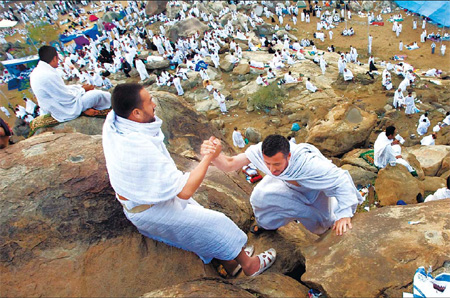
Muslim pilgrims climb Mount Mercy on the plains of Arafat outside the city of Mecca yesterday. The haj is one of the world's biggest displays of mass religious devotion and a duty for Muslims who can perform it. Reuters

MECCA, Saudi Arabia: Officials say at least 77 people have died in Saudi Arabia and 900 were rescued after the heaviest rainfall in years.

A spokesman for the Saudi interior ministry, Brigadier General Mansour al-Turki, said yesterday that none of the casualties were among the millions of pilgrims who are in Saudi Arabia for the haj.

The four-day pilgrimage, which started on Wednesday, draws more than three million people from every corner of the globe. The downpours ceased yesterday but there were fears of more rain to come.

State-run media said Wednesday's deaths were in Jiddah, Rabigh and Mecca. The statement blamed the deaths on flooding and collapsed homes. The port city of Jiddah is the country's main entry point for the pilgrims.

Government official Jassem

al-Yaqout said on Wednesday that two bridges on the motorway to Mecca collapsed. A power outage hit parts of the port city, the state news agency SPA said. Local Saudi newspapers have repeatedly reported on the poor condition of the city's sewage infrastructure.

In central Mecca, pilgrims with umbrellas usually used to protect against the sun walked the ritual path seven times around the Ka'aba, the ancient cube-shaped shrine which Muslims face when they perform their daily prayers.

Some worried they would be unable to spend the night in a tent camp in a valley in Mina as they follow the route Prophet Mohammad took 14 centuries ago.

Stampede, H1N1 alert

Authorities are scrambling to deal with sudden, unexpected downpours that could worsen one of the gathering's perennial dangers: deadly stampedes.

In 2006, all it took was a dropped piece of luggage to trip up a crowd and cause a pileup that killed more than 360 people at one of the holy sites. The rains also could cause flash floods or mudslides in the desert mountains where most of the rites take place.

Saudi Arabia's biggest worry for months ahead of the haj was swine flu. The Saudi government has been working with the US Centers for Disease Control and Prevention (CDC) to set up clinics and act to stem any outbreak.

Signs at the airport and around the holy sites urge the faithful to cover their faces when they cough, wash their hands and use anti-flu medications that are on hand.

Hassan El Bushra, an epidemiologist in the Cairo office of the World Health Organization, said "there is no evidence" that the rain would worsen the spread of the virus. It is carried in the air, by sneezes, coughs and touch - not waterborne. The rain could even be beneficial if it means crowds are smaller, he said.

So far, four pilgrims have died from H1N1 flu since arriving in Saudi Arabia, and 67 others have been diagnosed with the virus, Saudi Health Minister Abdullah al-Rabeeah told Al-Jazeera.

The crowds, seven people for every square meter, provide a perfect environment for H1N1 flu, said Shahul Ebrahim, a consultant at the haj from the CDC.

"Ideally you should be one meter away from someone to avoid catching the disease," he said.

But most visitors were too caught up in the exhilaration of the spiritual experience to worry. Nigerian pilgrim Omar Issa said he chose not to get a swine flu vaccination.

AP-Reuters

3 dead, 300,000 displaced in Sri Lankan flooding


COLOMBO: The Sri Lankan government said Wednesday that three people were killed while 302,835 people of over 83,000 families marooned by floods in the east.

Related readings:
Sri Lankan asylum-seekers disembark in Indonesia
Saudi floods kill 77, strand hundreds during haj

Pradeep Kodippily, assistant director of the Disaster Management Center, told reporters that Ampara and Batticaloa districts in the Eastern Province were the worst affected.
Kodippily said heavy rains lashed the area on Monday and Tuesday and the deaths were caused by lightning and the collapse of a wall.

The Disaster Management Center has opened eight camps to house those displaced by floods.

The atmospheric disturbance which caused heavy rains should continue and wet weather condition would prevail for some time, the Meteorological Department said.

Wednesday, December 16, 2009

Green Power Rules!


ISIS Report 16/12/09

A ground-breaking launch conference for Green Energies - 100% Renewable by 2050 and turning point for renewable and sustainable energies Sam Burcher

The Jubilee Room in Westminster was packed to the rafters for the launch conference (25 November 2009) hosted by Michael Meacher MP and Alan Simpson MP, just weeks before the Copenhagen Climate Summit. Every seat, every spare inch of table space and standing room was abuzz with expectation.

It was an extraordinarily high- powered panel of speakers assembled for the occasion; half of them coming from abroad.

UK not green

Prof. Peter Saunders, co-Director of ISIS opened the conference bang on time by delivering an opening salvo to the UK government for its reliance on nuclear power, carbon capture and storage and carbon credits. “It’s hard to believe they take renewable energies seriously when despite all the talk, out of the 27 countries in the EU we come 25th in the proportion of our energy that comes from renewables.”

As to UK’s reliance on carbon credits:”Either these reflect CO2 that was never going to be emitted, in which case they are bogus, or they mean people who are poorer than us are going to have to cut more than their fair share while we cut less, which is immoral.”

Green power to the people

Dr Mae-Wan Ho, Director of ISIS and lead author of the Report gave the first speech (see Power to the People, 100 Percent Renewables by 2050, SiS 45) Her message was “Power to the people!” in all senses of the word power. Renewable energy is inexhaustible, it is free once you installed your equipment to capture it, and it is available to all, so no need to fight over it. People themselves are in control.
Basically, green power is renewable, environmentally friendly, healthy, safe, and sustainable. It is especially amenable to distributed, decentralised small scale
generation that give people energy autonomy.

She emphasized that climate change is real and human activities have a lot to do with it, especially by burning fossil fuels. “That happens to be the best explanation of
all the observations, past and present.” She said, alluding to the hacked e-mails from East Anglia University that has been blown up by climate sceptics. “But being green is a good end in itself, regardless of whether you believe in climate change.”

The potential for renewable energies are huge. Top of the list are wind, solar and anaerobic digestion of biological wastes. She warned against false solutions such as nuclear, carbon capture and storage, and in particular biochar that’s in many ways intended as a successor to the already disastrous biofuels boom, and could really endanger life on earth by accelerating the depletion of oxygen.

And being 100 percent renewable by 2050 is realizable. Germany is well on course, thanks to enlightened government legislations and subsidies to stimulate the internal market, especially feed-in tariffs.

She ended by giving a peek at the fantastic possibilities “over the rainbow” that’s also covered by the Report.

As though on cue, the next two speakers gave brilliant examples of green people power

Find out what the other speakers had to say here
http://www.i-sis.org.uk/GreenPowerRules.php

Or read other articles about energy generation here
http://www.i-sis.org.uk/scienergy.php
========================================================
This article can be found on the I-SIS website at
http://www.i-sis.org.uk/GreenPowerRules.php

Wednesday, December 9, 2009

The Politics of Green Energy


ISIS Report 09/12/09

Rt. Hon Michael Meacher MP, former environment minister tells how UK is struggling to shift towards renewable energies, and what the Government must do to get there,
easily.


I want to start by paying tribute to The Institute of Science in Society (ISIS) for Science in Society magazine, which I think in terms of that very important interface
between science, the environment and politics it fills magnificently well. I’m sure it’s done on a shoestring budget, but the result is really remarkable, and every time
it reaches me, I know I’ve got a very good read.

What are the barriers to green energy? What is it where Sweden is 41 percent, Finland is 29 percent, Denmark is 17 percent, France is 10 percent, Germany 6 percent, and UK 1 percent? We all know what we are talking about - the degree of utilization of renewables for energy in general, and for electricity in particular.

I will talk about where we are very briefly, what the barriers are and how we should try to overcome them. What are the barriers?

No money

First of all money, but of course money is a barrier to many good things. The fact is that the Government did start a low carbon building programme in 2006. It opened at 10AM and by half past noon; the 12.7 million was entirely exhausted. As McEnroe would say, “You cannot be serious!”

There were 100 grants given for groundswell heat pumps, and the next year there were none at all. For solar panels there were 270 grants in 2007. Just look at that 270; in Germany there were 130 000 in the same year, nearly 500 times. There is one main reason for that: feed-in tariffs. Portugal, Spain, Germany and many other countries have used these extensively. Portugal is now at about 40 percent of electricity from renewable sources expected at 60 percent at 2020. In the UK we are at 4 percent and we will be very lucky to reach a target of 15 percent by 2020.

No domestic market

The second reason for poor uptake of renewables is that there is no domestic market. We have a great wind resource here in the UK simply because 250 000 years ago, we became an island as the result of two enormous floods and we are surrounded by sea water which is pretty choppy and pretty windy. Anyone who has stood on the end of piers at party conferences and nearly got blown off them would know.

The fact is however, that the domestic market for renewables doesn’t exist. The British Wind Power Association will tell you that they can generate at least a quarter of electricity by 2020 and we are now at 1.5 percent. I complain as
bitterly as anyone when Vestas (the wind turbine factory)moved out of the Isle of Wight and went off to America. But I have to admit there was a perfectly sane commercial reason for doing so because there is a big domestic market in the
United States. We don’t often hear about it, but Texas, of all places, and North and South Dakota have enough wind power to produce enough electricity for the whole of the US, which is a staggering thought. There is a huge market there, but here the potential is enormous and we have hardly taken it up at all.

No planning

The third reason is planning. It may surprise you to know that, and it staggered me to know that there are 220 wind projects currently stuck in planning. If all of those were approved, it would provide about 9.3 Gigawatts of electricity. That is about one seventh of the total UK requirement and rather interestingly, it about equals the output of the ten or eleven nuclear power stations that the Government is planning instead. The fact is that it can take nearly ten years to get approval for a wind farm and another five years in addition to that to get connection to the grid. Again, “You cannot be serious!”

The Government, of course, has proposed changes to the system, which I and a number of others have objected to, and I’ll explain why in a moment. Namely to have national planning statements and infrastructure planning commissions to decide without regard to what the locals might think, or anything else we go ahead with this. Well you might say in terms of wind farms that’s not a bad idea. The trouble with this is, of course, that it also includes motorways, power-stations, airports, incinerators and all the lot. And, it just doesn’t seem to have occurred to the Government that we might be able to transform the planning system for renewables only. That would be a wonderful thought, but it just hasn’t happened.
Surrounded by waves but still no tidal power.

The fourth point I would like to make is with regard to tidal power. In terms of wave and tidal power, we are surrounded by the sea. We have 30 marine technology developers headquartered in our country. When I say that there are only 15 in the whole of the rest of the EU, which numbers half a billion people, we have it all centred here, which is exactly what you would expect; and we have the world’s first commercial scale wave generating array. It was built in this country, and where is it being pioneered, where is it being tried out? In Portugal.

The fact is that we could generate 20 percent of our electricity from wave and tidal power. We could generate certainly a further 40 percent from offshore and onshore power. We could certainly lead the world in a new manufacturing sector, which in terms of our recession could create thousands of jobs far more than any building of any nuclear reactors. And we could have a zero carbon electricity grid by 2020.
Where’s the money for renewables?

Ok. I can hear the questions coming - what about the money? Well, I wouldn’t be so rude as to suggest that some of the £140 billion, which we paid to the Banks, that’s about 10 percent of our GNP. If we got a small fraction of that we could do a hell of a lot in terms of renewables. That’s the imbalance of it. And, if you think that’s a bit extravagant because the Banks are terribly nice and we need them, then let me just say that the Mox Plant, which I bitterly resisted, and that’s probably one of the several reasons for my removal; there are several others, of which GM is certainly quite a big one. But whatever the reason, the Mox Plant in Cumbria, which was designed to reuse spent nuclear fuel by re-processing it for a second round of burning, supposed to be the great new answer for virtually costless energy. I asked the question about six months ago after it had been in operation for eight years: it cost £350 million, and was intended to produce 120 tonnes of Mox fuel; but at the end of the eight years produced only six tonnes. That project cost £470 million in total, which could have been money rather better spent.

World’s first Carbon Budget Bill

However, let me say that things are getting better because they have to. It is very good when you are a Government MP and you get to praise your own side, which I occasionally do and it really wrong foots them when I do. But it is important to give credit where credit is due. And, credit is due over this question of carbon budget. This is the world’s first Government to have passed a Bill for 5-year carbon budget periods, (I think it should be shorter) in which we have got to reduce CO2 emissions to reach our target. In 1990 (the arbitrarily set dateline for carbon accounting) we were at 160 million tonnes of CO2. We’ve got to get down to 32 million tonnes if we’re going to have an 80 percent reduction. That’s the figure the Government has statutorily committed itself to, which I think is absolutely right. The point I’m making is that you cannot get there, anywhere near there simply by reductions on fossil fuels. We should do everything we can to squeeze fossil fuels, I’d like to be able to phase them out, but we’re not going to be able to do that quickly, but we should squeeze them down. The only way that we can get within sniffing distance is by a massive, massive increase in renewables. And that’s one very big driver.

The second big driver is the global low carbon economy as we come out of this recession, and everyone agrees it’s the worst for nearly 100 years. And we can only maintain our position in energy export markets if we have a good record of switching very strongly into renewables. As indeed many other countries have and just to put it in perspective, I was surprised when I read the other day that world investment in renewables last year exceeded world investment in fossil fuels. That’s a very significant tilting point. And I know from my long experience in politics and so many other processes that when the system begins to tilt it gathers momentum quite quickly.

40% electricity from renewables by 2020

The EU can also do a lot of good things and they have agreed 202020. What that means is there has to be a 20 percent improvement in energy efficiency by 2020. We ought to be able to get there easily considering the waste of energy, and a switch to 20 percent of all our energy from renewables, which certainly means that the proportion of our electricity generation which comes from renewables won’t have to be 20 percent, it will have to be nearer 40 percent, and today it is 4 percent. We have eleven years to go until 2020 and that’s a massive change and a statutory requirement. In the UK, if we fail to achieve it, we could be subject to significant penalties from the EU.

How do we achieve carbon reduction?

Create a domestic market

First, we need to create a domestic market. I think that the Government’s current investment of £12 million is inadequate. We need to be demanding something in the region of £10 billion. I do say, and this is not meant to be facetious, that if we can fork out £40 billion for the first financial crisis bail out, 40 billion for the second bail out and we now discover that there was a further £60 billion that we were not told about. I wonder how many other things? But even that is £140 billion. If we can afford that, I mean where did it come from? It’s extraordinary. If we can put something in the order of £10 billion in creating a domestic market for renewables, it would create many new jobs. And, it would empower us at a time when renewable energy is going to be a critical issue in this next decade. It would put us in a world leading position as well as taking advantage of our geography and our ecology, and what that offers.

Ensure access to the grid

Second, we need to ensure access to the grid. The barrier to that is the fossil fuel abusers who are determined to maintain their priorities and their dominance of the grid. Obviously coal, gas and nuclear predominate. It just simply means the political will to face them down and absolutely insist that the renewables get a significant and increasing share and there must be no administrative or other blockages.

Microgeneration for win-win-win situation

Third, to achieve carbon reduction we’ve got to do more on feed-in tariffs as we have seen in Germany (also see Alan Simpson’s Faith Hope Chaos). Microgeneration is the future. There is no question about this. There are enormous nuclear dinosaurs stuck in the countryside costing billions to build where 50 percent of energy is lost in production and further 5 percent in transmission. Microgeneration is the way out, but you’ve got to give people an incentive. People in Germany are given a very good price for investing in this and when you sell it to the grid the profit that you make is going to make it a very worthwhile investment. It’s a win-win-win situation for the country, for the individual and for energy security, which is what Governments are always going on about.
Carbon tax not carbon offsetting

Finally, you’ve got to tilt the market in an important way towards renewables. The real requirement is the will. The aspiration is there and there has been a lot of talk about a carbon tax. I think the Government has made it very clear that they want to see the carbon tax as one of the main objectives of Copenhagen. I’m one of those who still remain faintly optimistic that we will get some kind of political deal, but a carbon tax is very much needed. Yes, we’ve got a climate change levy and a climate change agreement, which the Government introduced. These are fine. The trouble is that the exclude the domestic sector and they exclude public transport and both of those are very big and very important generators of emissions. So they’ve got to be included and I think a carbon tax is obviously the right way to do it.

In addition, we should end carbon offsetting. This is the really big cheat. What is says is that we’re going to set ourselves one of these very big targets probably so far ahead that our Government would have disappeared into history. I want to see progress at the start, not at the end of the process. I’m all in favour of big targets so long as we have big targets fairly near the beginning. But whatever size the target, the important thing is that you can’t cheat by buying it all abroad. It means technically that you can make hardly any change at all in terms of emissions reductions in Britain, that you can meet your targets simply by buying abroad, by improving factories in Bangladesh, by building a new facility in China, etc, etc. I’m all in favour of doing these other things, but they shouldn’t count towards our domestic target. We need to see the changes here.

I remain as always an optimist, whether on the back benches, or anywhere else. I believe that however many reverses we take, and when you’re in the Labour Party you have to take a few reverses, but however many you take, in the end we can succeed.

Transcribed by Sam Burcher at the Green Energies meeting at Westminster, 25th November, 2009; edited by Sam Burcher and Dr Mae-Wan Ho.

Or read other articles about energy generation here
http://www.i-sis.org.uk/scienergy.php
=====================================================================================
This article can be found on the I-SIS website at
http://www.i-sis.org.uk/thePoliticsOfGreenEnergy.php

http://www.i-sis.org.uk/ISISappeal.php

ISIS is an independent, not-for-profit organisation dedicated to providing critical public information on cutting edge science, and to promoting social accountability and ecological sustainability in science.

Compute your carbon footprint

Calculate your Car's Carbon Impact
Based on EPA and Intergovernmental Panel on Climate Change (IPCC) Values
Trip Carbon Footprint Calculator for Gasoline Engine
Miles Driven Trip MPG Average
Trip Carbon Impact
City:
lbs. of CO2
Highway:
lbs. of CO2
Total Trip Emission:
lbs. of CO2
How many times do you drive like this per month?
Estimated Annual Emission:
Tons of CO2

PANACEA-BOCAF

This idea describes two technologies that can help every person on the planet, save energy, stop pollution and help reduce global warming. We need your help to help you please vote for this idea.

URGENT MESSAGE #1

I personally do not agree with idolatry or cult personalities - I am merely posting these videos for the worthy educational contents - and I am not endorsing any of the perosnality intending to be idolised or praise or worshipped in these videos. Please stick with the contexts or contents only and discard the unimportant details like superlative titles to individuals.